Menu
Mallarmé memory boat w/ Liliane Giraudon
Text-sound performance
2025 - 2026
Catalogue number : 100
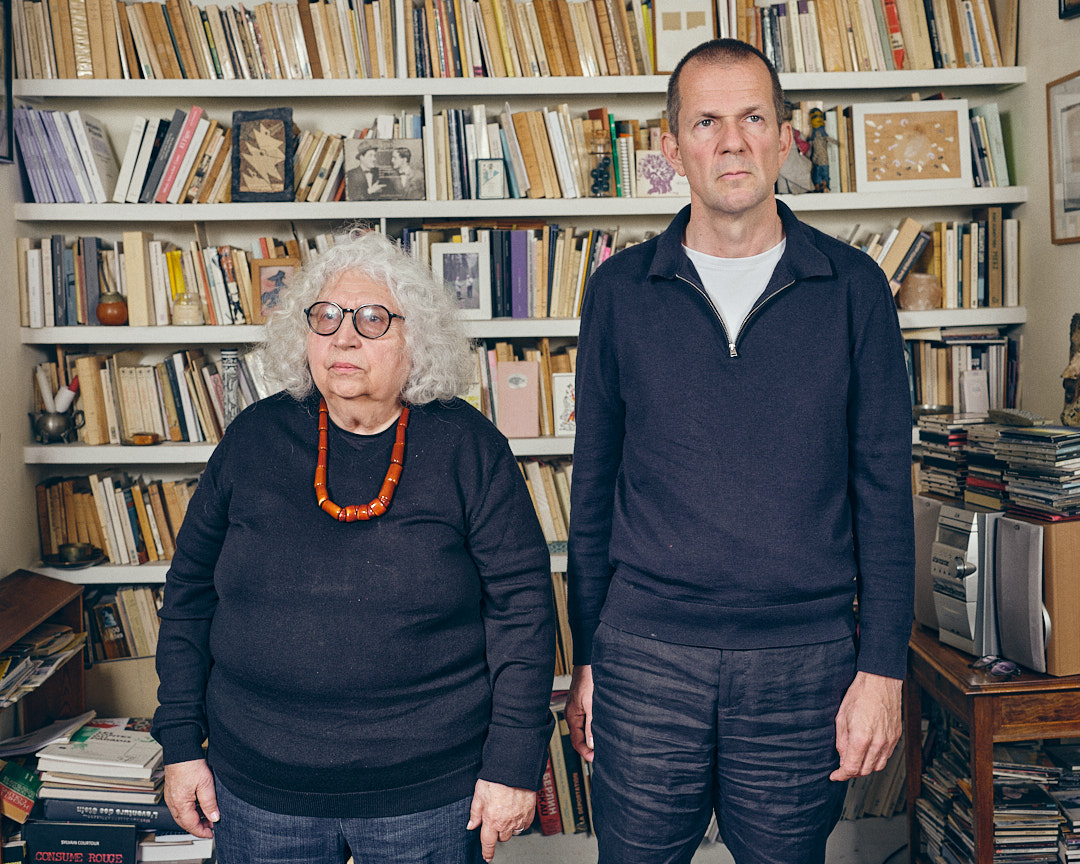
Ph. Andrea Graziosi
During the spring and summer of 2025, Alessandro Bosetti and Liliane Giraudon spent many mornings together attempting to learn Stéphane Mallarmé’s Un coup de dés by heart.
The occasion was provided by the retrospective devoted to the Marseille poet by the Centre International de Poésie Marseille (CIPM) in September of the same year. For the exhibition opening, Giraudon invited Bosetti to conceive a sound performance that they would present together.
While Alessandro Bosetti has long been engaged in a research practice focused on sonic memory and the musicality of language, Liliane Giraudon had turned her attention to the work of Stéphane Mallarmé. The meeting of these two trajectories almost naturally gave rise to the idea for the performance from which this text emerged.
All memorization sessions were recorded. Bosetti and Giraudon sat side by side in the latter’s studio, a space crowded with books and objects, with a dry acoustic particularly suited to recording, in her apartment on Boulevard Prado in Marseille.
The result is a corpus of more than ten hours of audio documenting the attempt to memorize the long poem—nearly twenty pages arranged in Mallarmé’s singular graphic layout, scattered across the space of the page—and already sketching out a form of its own. The poem’s lines return cyclically through repeated attempts at memorization, intertwining with countless digressions and deviations. Bosetti, whose native language is Italian, continually asks questions and seeks clarification; Giraudon, deeply attached to the Mallarméan legacy, could speak about it endlessly.
The recordings proceed through successive layers of fragments from the same text, like a palimpsest. The conversation develops as a spiral, a two-voiced invention animated by the tension between two forms of memory. Bosetti, younger, appears genuinely engaged in memorization: he struggles, falters, and gradually reconstructs the poem phrase by phrase. Giraudon, because of her age, claims to be “losing her memory” and unable to memorize it, yet she continues to pour into the flow of conversation an abundance of reflections, analyses, quotations, and anecdotes—Mallarméan and otherwise. Rather than a memory dissolving, her speech gives shape to a landscape that is constantly shifting, becoming disarticulated, and perhaps refusing fixation because fixation has become unnecessary.
Throughout the preparation process, Giraudon wonders about the sonic form the performance might take, about the kind of “music” it could become, while Bosetti postpones the moment of acknowledging that spoken language itself—its rhythm, hesitations, and the polyphonic tensions of a conversation between two people—already constitutes a musical form to which little needs to be added.
The two positions eventually become intertwined. Memory becomes a shared fabric, the same boat (stessabarca), a house built upon nothingness. Memory as a musical instrument, as an object, as material, as shipwreck, as song.
In the end, two techniques dear to both artists prevail. On the one hand, extraction: around one hundred sentences are selected, transcribed, refined, and assembled into a new mobile corpus that can be traversed in every direction. On the other hand, a device that allows one, by pressing keys on a keyboard, to randomly summon one of these sentences together with a sound, itself drawn from a catalogue of around fifty abstract sounds composed by Bosetti.
On the day of the performance, the two artists sit side by side in the courtyard of La Vieille Charité in Marseille before a large audience. Giraudon wears a mask depicting Bosetti’s face and sits in front of the keyboard that allows her to activate phrases—fragments of their past conversations. Bosetti wears no mask—speaking French is already a mask in itself—and improvises a discourse that he weaves together with the selected excerpts.
The duration of the performance, as well as of its later versions—two of which are transcribed in this booklet under the title Volées—is twelve minutes, a symbolic number in the universe of Un coup de dés.
What remains is to understand what, in this process, is specifically “musical.” It may be that memory itself is one of the terms in the equation of musical relationships. Harmony was once built from prime numbers; later, irrational numbers and elusive roots were introduced. Finally—or perhaps at the very beginning—memories entered the picture: fractions, unstable relationships, multiplied and divided elements placed in relation to one another.
This libretto is both the sediment and the trace of a mnemonic and sonic gesture carried out by the two artists. It is composed of three parts: two Volées, transcriptions of two live versions of the performance, and a Crossfade, which initially appears to be an interview between Bosetti and Giraudon but gradually blurs and reverses their respective voices as the exchange unfolds.
Crossfade—the English term for a gradual transition between two sounds—translates here, both literally and literarily, the gesture performed by Giraudon during the performance: wearing her partner’s mask. It is a gesture reminiscent of a huntress entering the forest draped in the still blood-soaked skin of one of the animals whose spirit she wishes to encounter—or perhaps simply whose song she hopes to learn.
[sound_iframe_sc]
Mallarmé Memory Boat
performance sonore de et avec Alessandro Bosetti et Liliane Giraudon
créée à l’occasion du vernissage de l’exposition
Liliane Giraudon madame himself & l’humour poétasse
orchestrée par Cécile Marie-Castanet.
Centre International de Poésie Marseille (cipM) –
© Alessandro Bosetti / 2026